

Java 11 Nest-Based Access Control Via Reflection
Learn more about nest-based access control via Java 11 reflections.
 CORE
·
CORE
·
Join the DZone community and get the full member experience.
Join For Free
Among the features of JDK 11, we have several hotspots (changes at the bytecode level). One of these hotspots is known as JEP 181, or nest-based access control (nests).
Basically, the nest term defines a new access control context that allows classes that are logically part of the same code entity, but which are compiled with distinct class files, to access each other's private members without the need for compilers to insert accessibility-broadening bridge methods (Java documentation).
So, in other words, nests allow nested classes to be compiled to different class files that belong to the same enclosing class. These are then allowed to access each other's private classes without the use of synthetic/bridge methods.
Let's consider the following code:
public class Car {

   private String type = "Dacia";

   public class Engine {

      private String power = "80 hp";

      public void addEngine() {
         System.out.println("Add engine of " + power
            + " to car of type " + type);
      }
   }
}
Let's run javap (the Java class file disassembler tool that allows us to analyze the bytecode) for Car.class in JDK 10. The following screenshot highlights the important part of this code:
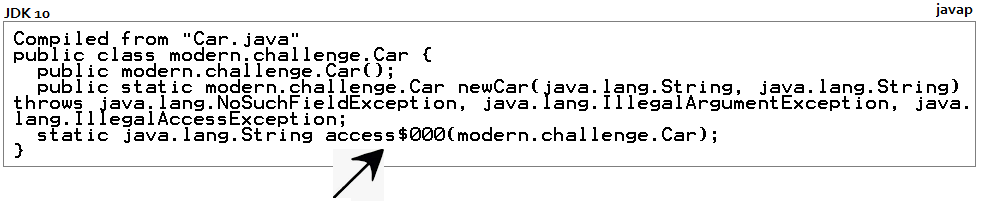
As we can see, to access the enclosing class field, Car.type, from the Engine.addEngine() method, Java has altered the code and added a bridge package-private method known as access$000(). Mainly, this is synthetically generated and can be seen via reflection using the Method.isSynthetic() and Method.isBridge() methods.
Even if we see (or perceive) the Car (outer) and Engine (nested) classes as being in the same class, they are compiled to different files (Car.classand Car$Engine.class). Conforming to this statement, our expectations imply that the outer and the nested classes can access each other's privatemembers. But being in separate files, this is not possible. In order to sustain our expectations, Java adds the synthetic bridge package-private method, access$000().
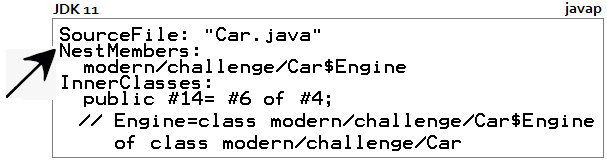
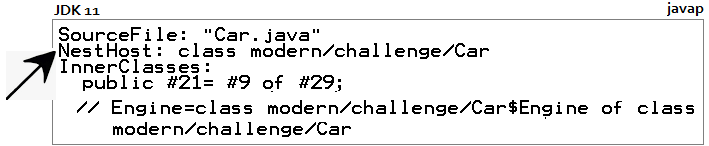
However, Java 11 introduces the nests access control context, which provides support for privateaccess within outer and nested classes. This time, the outer and nested classes are linked to two attributes and they form a nest (we say that they are nestmates). Mainly, nested classes are linked to the NestMembers attribute, while the outer class is linked to the NestHost attribute. No extra synthetic method is generated.
In the following screenshot, we can see javap being executed in JDK 11 for Car.class (notice the NestMembers attribute):
The following screenshot shows the javap output in JDK 11 for Car$Engine.class (notice the NestHost attribute):
Access via the Reflection API
Without nest-based access control, reflection capabilities are also limited. For example, before JDK 11, the following snippet of code would throw IllegalAccessException:
Car newCar = new Car();
Engine engine = newCar.new Engine();

Field powerField = Engine.class.getDeclaredField("power");
powerField.set(engine, power);
We can allow access by explicitly calling powerField.setAccessible(true):
...
Field powerField = Engine.class.getDeclaredField("power");
powerField.setAccessible(true);
powerField.set(engine, power);
...
Starting with JDK 11, there is no need to call setAccessible().
Moreover, JDK 11 comes with three methods that enrich the Java Reflection API with
support for nests. These methods are Class.getNestHost(), Class.getNestMembers(), and Class.isNestmateOf().
Let's consider the following Melon class with several nested classes (Slice, Peeler, and Juicer):
public class Melon {
   ...
   public class Slice {
      public class Peeler {}
   }

   public class Juicer {}
   ...
}
Now, let's define a Class for each of them:
Class<Melon> clazzMelon = Melon.class;
Class<Melon.Slice> clazzSlice = Melon.Slice.class;
Class<Melon.Juicer> clazzJuicer = Melon.Juicer.class;
Class<Melon.Slice.Peeler> clazzPeeler = Melon.Slice.Peeler.class;
In order to see NestHostof each class, we need to call Class.getNestHost():
// class modern.challenge.Melon
Class<?> nestClazzOfMelon = clazzMelon.getNestHost();

// class modern.challenge.Melon
Class<?> nestClazzOfSlice = clazzSlice.getNestHost();

// class modern.challenge.Melon
Class<?> nestClazzOfPeeler = clazzPeeler.getNestHost();

// class modern.challenge.Melon
Class<?> nestClazzOfJuicer = clazzJuicer.getNestHost();
Two things should be highlighted here. First, note that NestHost of Melon is Melon itself. Second, note that NestHostof Peeler is Melon, not Slice. Since Peeler is an inner class of Slice, we may think that its NestHostis Slice, but this assumption is not true.
Now, let's list NestMembers of each class:
Class<?>[] nestMembersOfMelon = clazzMelon.getNestMembers();
Class<?>[] nestMembersOfSlice = clazzSlice.getNestMembers();
Class<?>[] nestMembersOfJuicer = clazzJuicer.getNestMembers();
Class<?>[] nestMembersOfPeeler = clazzPeeler.getNestMembers();
All of them will return same NestMembers:
[
  class modern.challenge.Melon,
  class modern.challenge.Melon$Juicer,
  class modern.challenge.Melon$Slice,
  class modern.challenge.Melon$Slice$Peeler
]
Finally, let's check nestmates:
boolean melonIsNestmateOfSlice
   = clazzMelon.isNestmateOf(clazzSlice); // true

boolean melonIsNestmateOfJuicer
   = clazzMelon.isNestmateOf(clazzJuicer); // true

boolean melonIsNestmateOfPeeler
   = clazzMelon.isNestmateOf(clazzPeeler); // true

boolean sliceIsNestmateOfJuicer
   = clazzSlice.isNestmateOf(clazzJuicer); // true

boolean sliceIsNestmateOfPeeler
   = clazzSlice.isNestmateOf(clazzPeeler); // true

boolean juicerIsNestmateOfPeeler
   = clazzJuicer.isNestmateOf(clazzPeeler); // true
The complete code is available on GitHub.
If you enjoyed this article then you'll love my book, Java Coding Problems that contains a dedicated chapter including 17 problems that involve the Java Reflection API. Thi book is dedicated to Java beginners-intermediates that want to sharp their JDK8-JDK12 skills.
Further Reading
Opinions expressed by DZone contributors are their own.
Comments